How Strait of Hormuz Disruption Exposes a Western Supply Chain Crisis in Critical Minerals
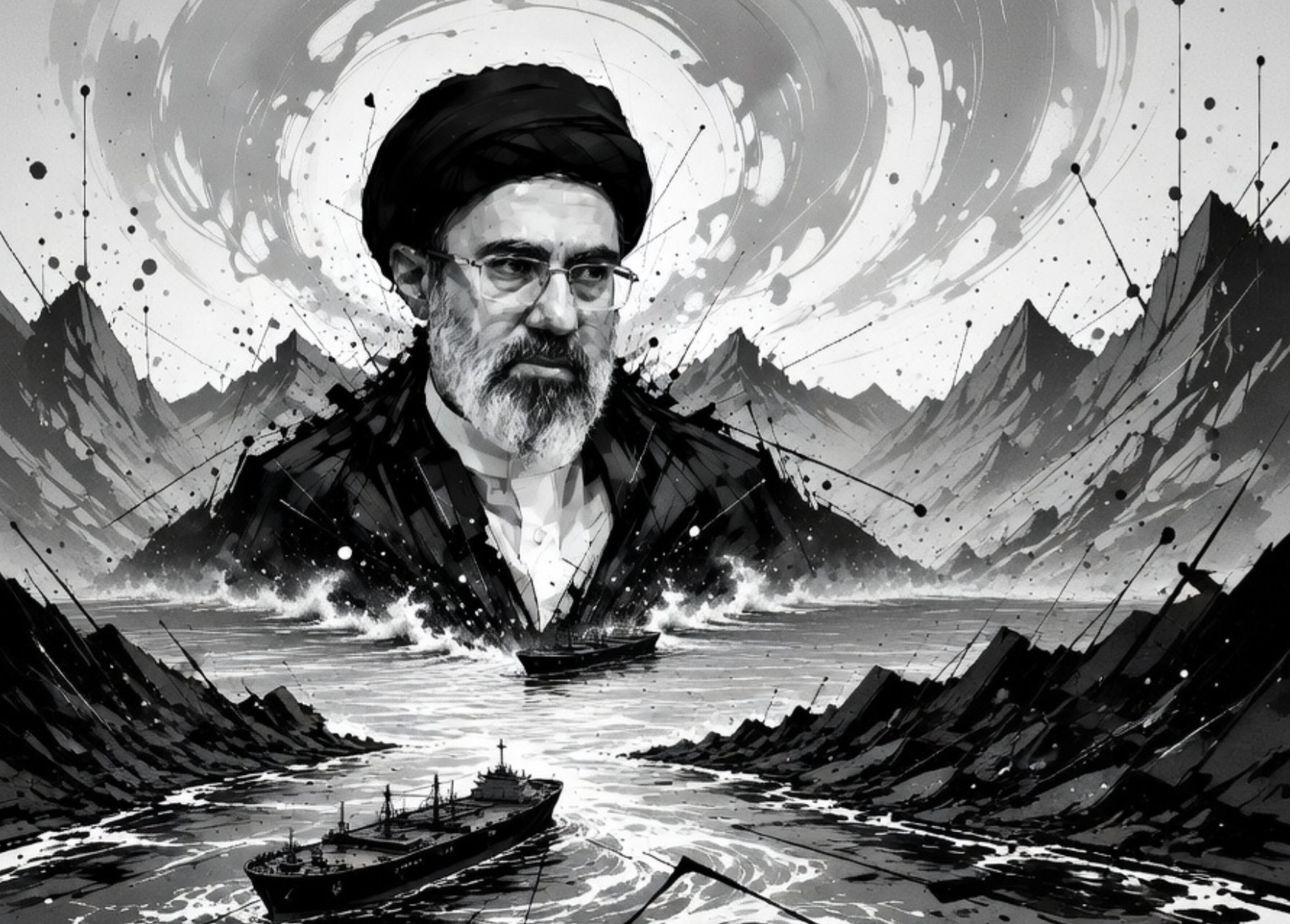
Iran has essentially closed the Strait of Hormuz, a narrow waterway through which about 20% of the world's oil flows. Image: RTK
The strategic context and why this crisis is ‘different’
⟁ OPINION | Tina Abelshauser, Fri 20 Mar, 2026Cite | Share
For policymakers and business leaders tracking critical mineral supply chain risks, the Iran war has shifted the terms of the debate. What were once theoretical vulnerability assessments are now operational realities. Every F-35 over the Gulf, every precision munition launched, runs on the same cobalt, copper, gallium and rare earth elements that underpin the global technology economy — and the bulk of those materials flow through supply chains overwhelmingly controlled by China.
The effective closure of the Strait of Hormuz — the chokepoint through which roughly one-fifth of global oil passes — is compounding a minerals crisis that predates this conflict. China's export restrictions on critical minerals, imposed in 2024, were already forcing a reckoning. The Hormuz disruption adds a second vector of fragility, exposing the degree to which processing chemicals, logistics corridors and maritime insurance underpin an interconnected and underappreciated global supply chain.
"It isn't necessarily that the Iran conflict is causing a new issue around critical mineral supply chains. It's just highlighting the importance of diversification."
ASHLEY ZUMWALT-FORBES, BAKER INSTITUTE; FORMER US DEPARTMENT OF ENERGY OFFICIAL
The China dependency problem: a supply chain built for a different era
The thirteen minerals for which the United States is wholly dependent on imports — arsenic, bismuth, gadolinium, germanium, graphite, hafnium, nickel, samarium, tungsten, vanadium, ytterbium, yttrium and zirconium — have one feature in common: China is the dominant producer of each of them. This is not coincidence. It is the accumulated consequence of decades of underinvestment in domestic extraction and processing capacity across the Western world, combined with China's deliberate, long-term strategy to own the midstream of the green and defence technology transition.
Beijing's export restrictions, introduced in 2024, demonstrated the asymmetric leverage this creates. Washington's response — a Pentagon stockpiling initiative, Project Vault's $12 billion public-private financing vehicle, and the addition of copper to the US critical minerals list in November 2024 — signals genuine recognition of the problem. But as Zumwalt-Forbes has noted plainly: "In the interim, we are in a very compromised position." Mine permitting, processing facility construction and supply chain diversification are measured in years, not months.
Hormuz as a mineral choke point: the sulphur problem
The Strait of Hormuz is not merely an oil corridor. For the critical minerals industry, its disruption creates a distinct and underappreciated secondary crisis: the interruption of sulphur flows. The Middle East accounted for approximately 24 per cent of global sulphur production in 2025 and fully half of seaborne sulphur trade — and sulphur is a foundational reagent in the processing of copper and nickel, two minerals at the centre of both the energy transition and defence manufacturing.
The knock-on effects extend further. Mining operations are not self-contained: they depend on chemical reagents and processing compounds sourced globally. A prolonged closure of Hormuz disrupts those input chains regardless of where the ore is extracted. Raul Munoz, industry leader for mining and natural resources at Marsh, puts the vulnerability plainly: minerals extracted from the ground require processing, and that processing depends on reagents that must move through global shipping corridors.
"Depending on how long the continuing regional turmoil persists… this could potentially increase price volatility across the supply chain."
SAID BAKR, ARAB GULF STATES INSTITUTE
Gulf state responses: from consumers to strategic actors
The Gulf states' response to the critical minerals challenge represents one of the more consequential strategic pivots of the past decade. Saudi Arabia and the UAE have moved from passive consumers of global mineral markets to active investors in extraction, processing and strategic partnerships — driven by diversification imperatives but shaped by an increasingly sophisticated understanding of geopolitical risk.
The UAE's Abu Dhabi International Holding Company (IHC) has pursued an aggressive acquisition strategy: a Zambian copper mine in 2023, a joint venture in Angola in 2024, and agreements with Tanzania and Kenya covering nickel and other metals. IHC's chief executive has stated that their primary competitor in these markets is China — a telling frame for what is, in effect, a shadow competition for future supply chain influence. Copper is central to this agenda, given its role in powering data centres, AI infrastructure and the broader electrification of Gulf economies.
The war introduces genuine uncertainty into these strategies. As Rachel Ziemba of Ziemba Insights notes, the critical question for Riyadh and Abu Dhabi is how the conflict will affect the prioritisation and pace of their minerals investments, and how the disruption to maritime logistics affects their ability to move processed materials to global markets. Lithium carbonate, rare earth concentrates and refined copper all face the same Hormuz bottleneck that is currently throttling crude.
Policy implications: what governments and investors must now address
PRIORITY ACTIONS FOR GOVERNMENTS AND MULTILATERAL INSTITUTIONS
01 Accelerate strategic stockpile programmes with processing-layer logic
Stockpiles of raw minerals are insufficient. Governments must extend reserves to include processed intermediate materials and critical reagents — including sulphur — to buffer against logistics disruptions of the Hormuz type.
02Establish allied minerals logistics corridors as a strategic priority
NATO and Quad partners should treat minerals logistics — port access, shipping insurance frameworks, alternative transit routes — as a defence infrastructure question, not merely a commercial one.
03Urgently reform permitting timelines for allied-nation extraction projects
The multi-year permitting backlog in the US, Canada, Australia and Europe represents the single most tractable policy lever for reducing China dependency. Administrative reform must accompany financial commitments.
04Formalise Gulf state partnerships within allied minerals frameworks
UAE and Saudi Arabia investments in African and Central Asian extraction assets offer a complementary layer of diversification. Washington should integrate Gulf partners into strategic minerals frameworks rather than treating them as parallel actors.
05Require mandatory supply chain visibility for defence contractors
The blind spots identified by risk advisers in corporate supply chains are, in the defence context, a national security failure. Mandatory traceability requirements for tier-two and tier-three suppliers should be a baseline condition for government contracts.
The bottom line
The Iran war has not created the critical minerals vulnerability — it has illuminated it. For years, the risk of Western over-dependence on Chinese-controlled mineral supply chains has been acknowledged in policy documents and think-tank reports while institutional inertia slowed corrective action. The Hormuz disruption removes the theoretical dimension entirely: this is now a real-time supply chain stress event, with measurable consequences for defence readiness, energy transition timelines and industrial competitiveness.
The window for structural reform — investment in allied extraction capacity, supply chain transparency, processing facility development and multilateral minerals diplomacy — remains open. But the cost of continued delay, as this conflict is demonstrating, is no longer abstract.
References:
Aggressors’ in Hormuz are threatening Iran’s security – Iran foreign ministry, Cathy Newman Channel 4 (UK) Friday 20, March 2026
Seyed Abbas Araghchi, Foreign Minister, Islamic Republic of Iran, x.com/araghchi
Al Jazeera. (2026, February 16). Iran FM in Geneva for US talks, as IRGC holds drills in Strait of Hormuz. Al Jazeera English. https://www.aljazeera.com/news/2026/2/16/irans-araghchi-arrives-in-geneva-for-second-round-of-nuclear-talks-with-us
BBC, Trump says world has 10 days to see if Iran agrees deal or 'bad things happen', Feb 20, 2026
Council of the EU, The Joint Comprehensive Plan of Action (JCPOA)
World Steel Association. (2026, January). December 2025 crude steel production and 2025 global crude steel production totals [Press release]. worldsteel.org. https://worldsteel.org/media/press-releases/2026/december-2025-crude-steel-production-2025-global-crude-steel-production/
U.S. Energy Information Administration (EIA), Iran, Oct 10, 2024
Noor Mine, Opportunities and Challenges of Investing in Iran’s Mining Sector, July 15, 2025
International Energy Agency. Supply concentration risks in critical minerals markets, October 23, 2025
NB. All sources accessed March 6, 2026. URLs verified at time of publication. Unamine makes no representation as to the continued availability of external links.
How relevant and useful is this article for you?
★ 64
VSG works across the mining & metals value chain, positioning people who form the critical bridge to early-stage relationships in complex regions.